
Introduction
You know that feeling the one where your heart starts racing for no reason, your mind won’t stop running through a hundred “what ifs,” and you’re exhausted even though you slept eight hours? You might brush it off as stress, or tell yourself you’re just being too sensitive. But what if it’s more than that?
Anxiety symptoms in women are incredibly common and incredibly easy to miss or misread. That’s partly because anxiety doesn’t always look like what we expect. It doesn’t always mean you’re shaking in the corner. Sometimes it looks like being the most “put-together” person in the room while quietly falling apart inside.
This article is for every woman who has ever Googled “why do I feel so on edge all the time?” at midnight. We’re going to break down what anxiety actually feels like emotionally and physically why women are particularly affected, and what you can do about it.
What Is Anxiety, Really?
Anxiety is your brain’s way of responding to perceived danger or stress. A little anxiety is normal even helpful. It’s what makes you prepare for a big presentation or look both ways before crossing the street.
But anxiety becomes a problem when it won’t turn off. When the worry is constant, the physical symptoms become distracting, and the fear starts interfering with your daily life that’s when it crosses into anxiety disorder territory.
Anxiety disorders are actually the most common mental health condition in the world. And women are diagnosed with them at nearly twice the rate of men.
That’s not a coincidence and it’s not weakness. There are real biological, hormonal, psychological, and social reasons for this, which we’ll get into later.
Common Anxiety Symptoms in Women
Anxiety shows up differently for different people, but there are patterns that tend to show up more often and more intensely in women.
Emotional Symptoms of Anxiety
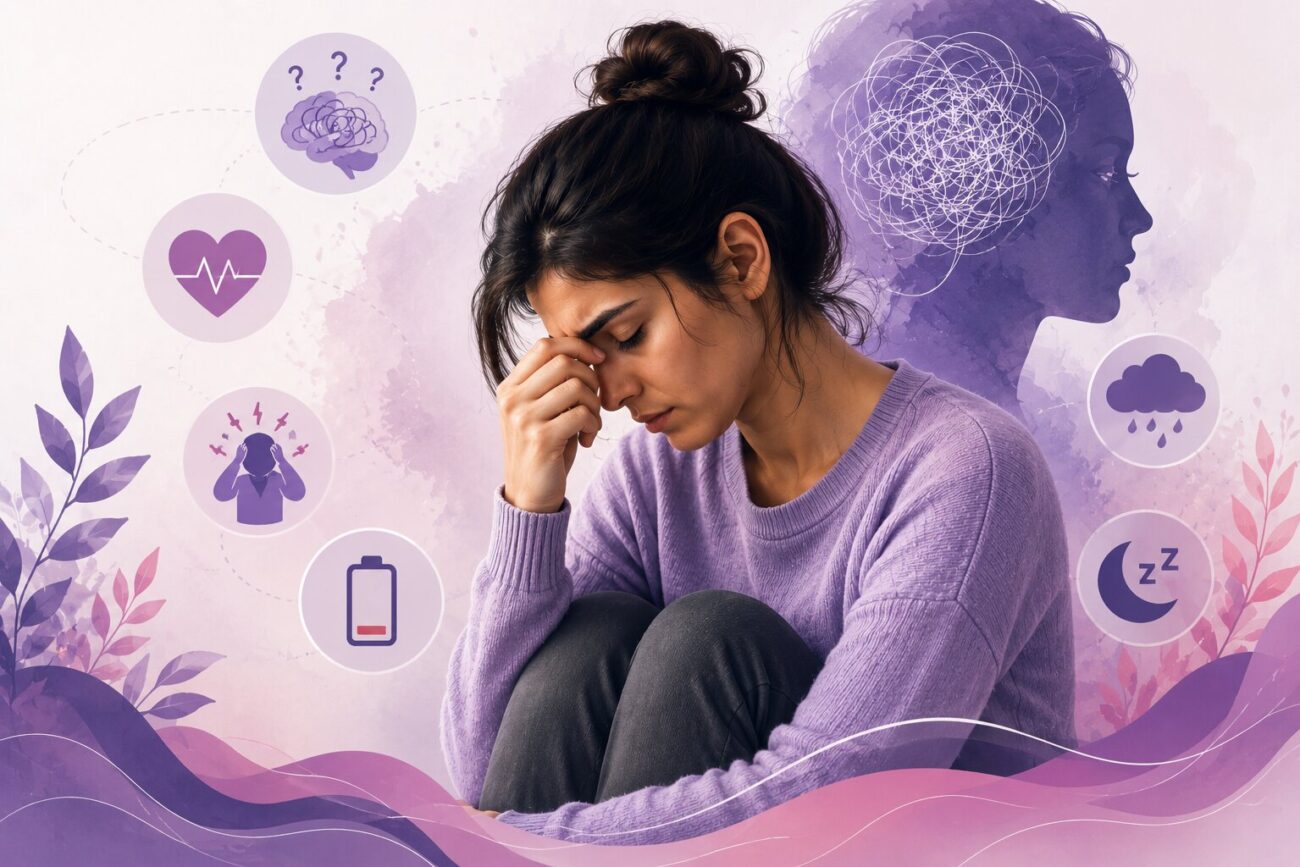
Anxiety symptoms in women often start in the mind before they ever show up in the body:
- Excessive worry that feels impossible to turn off
- Overthinking and rumination replaying conversations, anticipating worst-case scenarios
- Irritability or sudden mood shifts, often without an obvious trigger
- Feeling on edge, like you’re waiting for something bad to happen
- Difficulty concentrating or making decisions
- Fear of judgment or social situations
- Feeling like you’re “too much” or that something is fundamentally wrong with you
That last one is worth pausing on. Many women with anxiety carry a deep sense of shame about it they worry they’re overreacting, being dramatic, or can’t handle life like everyone else seems to. That shame often delays getting help.
You are not overreacting. Your feelings are real.
Physical Symptoms of Anxiety
This is where a lot of women get confused, because physical symptoms of anxiety can feel like a hundred other things:
- Chest tightness one of the most alarming and misunderstood symptoms
- Rapid heartbeat or heart palpitations
- Shortness of breath
- Muscle tension, especially in the neck, shoulders, and jaw
- Headaches or migraines
- Stomach problems nausea, IBS flares, digestive issues
- Dizziness or lightheadedness
- Tingling in hands or feet
- Fatigue that doesn’t go away, even after rest
- Sweating or feeling too hot
A lot of women end up in urgent care or see multiple doctors before realizing their physical symptoms have an anxiety component. That’s not weakness anxiety genuinely affects the body, and those symptoms are real.
Chest Tightness and Anxiety
Chest tightness from anxiety often mimics heart problems, which is why it’s so frightening. It’s caused by muscle tension and changes in your breathing pattern when you’re anxious.
If you’ve had it checked out and there’s no cardiac cause, anxiety is likely the culprit. Deep, slow breathing (more on that below) can help relieve it quickly.
Panic Attacks in Women
A panic attack is an intense surge of fear or discomfort that peaks within minutes. Anxiety attacks in women are more common than many people realize, and they can feel absolutely terrifying.
Signs of a panic attack include:
- Sudden, overwhelming fear
- Pounding or racing heart
- Difficulty breathing
- Feeling like you might faint or die
- Detachment from your body (derealization)
- Sweating, shaking, or nausea
The thing about panic attacks is that they’re not actually dangerous, even though they feel like a medical emergency. Your body is hitting a false alarm. They pass usually within 10–20 minutes.
If you’re having frequent panic attacks, that’s a clear sign to talk to someone. You don’t have to just “ride them out” forever.
Racing Thoughts and Overthinking
Overthinking is almost a defining feature of female anxiety and it often gets dismissed as “just worrying too much.”
But for women with anxiety, racing thoughts aren’t a choice. The brain gets stuck in a loop, replaying past conversations, catastrophizing future events, scanning for threats. It’s exhausting. It makes sleep nearly impossible. And it can feel deeply isolating.
Some women describe it as having a browser with 47 tabs open at all times and not being able to close any of them.
If this sounds familiar, you’re not alone. And it’s treatable.
Anxiety and Hormones: The Connection Women Need to Know About
One major reason anxiety in women looks different and often feels more intense is hormones.
Estrogen and progesterone don’t just affect your reproductive cycle. They directly interact with the brain’s anxiety regulation system. When these hormones fluctuate, anxiety symptoms often get worse.
Hormonal Triggers for Anxiety
- Premenstrual syndrome (PMS): Many women notice anxiety spikes in the week before their period tied to dropping progesterone levels.
- PMDD (Premenstrual Dysphoric Disorder): A more severe form of PMS that includes intense anxiety, mood swings, and depression.
- Pregnancy: Hormonal shifts plus life changes can trigger anxiety even in women who’ve never experienced it before.
- Postpartum anxiety: Often overlooked compared to postpartum depression, but extremely common. It can include excessive worry about the baby, intrusive thoughts, and panic attacks.
- Perimenopause and menopause: As estrogen declines, many women experience new or worsening anxiety often dismissed as “just aging.”
Tracking your symptoms across your cycle can be incredibly revealing. If you notice your anxiety is significantly worse at predictable times, that’s important information for your doctor.
Anxiety During Pregnancy
Anxiety during pregnancy affects up to 1 in 5 pregnant women yet it’s often undertreated because so much focus goes to physical health.
Symptoms can include excessive worry about the baby’s health, fear of childbirth, difficulty sleeping, physical tension, and racing thoughts. If anxiety is interfering with your ability to function or enjoy your pregnancy, please talk to your midwife or OB. There are safe, effective options.
Sleep Problems and Anxiety
Sleep problems and anxiety go hand in hand and they feed each other.
Anxiety makes it hard to fall asleep (because your mind won’t quiet down). Poor sleep makes you more anxious and emotionally reactive the next day. It becomes a cycle.
Women with anxiety often describe:
- Lying awake replaying the day
- Waking up at 3am with their heart racing
- Dreaming intensely or having nightmares
- Feeling unrested even after 8+ hours
Addressing your anxiety is one of the most effective ways to improve your sleep more effective, in many cases, than sleep aids alone.
Social Anxiety Symptoms in Women
Social anxiety is more than shyness. It’s an intense fear of being judged, embarrassed, or rejected in social situations and it can be genuinely disabling.
In women, social anxiety often shows up as:
- Avoiding social events even when you want to go
- Rehearsing conversations in your head ahead of time
- Replaying interactions afterward and cringing
- Difficulty speaking up in groups or at work
- Feeling deeply relieved when plans get cancelled
Social anxiety is highly treatable, but because it often looks like introversion or being “quiet,” it goes unrecognized.
High Functioning Anxiety: The Hidden Struggle
High functioning anxiety is not a clinical diagnosis but it describes something very real that many women experience.
These are the women who seem to have it all together. Successful, organized, always prepared. But underneath that competence is relentless anxiety driving everything.
Signs of high functioning anxiety:
- You appear calm on the outside but feel chaotic inside
- You overachieve to manage your fear of failure
- You say yes to everything, even when overwhelmed
- You can’t rest without guilt
- You over-prepare for everything
- You catastrophize privately, then perform competence publicly
If this is you you deserve support too. High functioning doesn’t mean you’re fine.
Anxiety vs. Stress: What’s the Difference?
Anxiety and stress are related, but they’re not the same thing.
Stress is a response to an external pressure a deadline, a conflict, a loss. When the situation resolves, the stress typically eases.
Anxiety tends to persist even when the external trigger is gone. It can feel like your nervous system is stuck in “on” mode, even when there’s nothing actively wrong.
Another key difference: anxiety often involves avoidance steering clear of situations that trigger your fear. Stress usually doesn’t.
Anxiety Causes in Women
Anxiety doesn’t have a single cause it’s usually a combination of factors:
- Biology and brain chemistry genetics play a real role
- Hormonal factors as we’ve covered
- Life experiences trauma, childhood adversity, difficult relationships
- Chronic stress caregiving, work overload, financial pressure
- Personality traits perfectionism, people-pleasing
- Medical conditions thyroid issues, vitamin deficiencies
- Caffeine and alcohol more impactful on anxiety than many realize
- Social and cultural pressure women face enormous societal expectations
Understanding your personal triggers isn’t about assigning blame it’s about knowing yourself well enough to intervene.
Generalized Anxiety Disorder in Women
Generalized anxiety disorder (GAD) is the most common anxiety disorder in women. It’s characterized by persistent, excessive worry about multiple areas of life health, relationships, work, finances that’s hard to control.
With GAD, the worry isn’t tied to one specific thing. It migrates. You solve one worry and find another. It’s exhausting, and it often wears women down quietly over years.
GAD is highly treatable with therapy, medication, or a combination but it’s frequently misdiagnosed or dismissed as “just stress.”
When Anxiety Becomes Serious
Anxiety moves from manageable to serious when it starts significantly interfering with your life. Signs it’s time to seek help:
- You’re avoiding things that matter to you because of anxiety
- You’re having frequent panic attacks
- Your relationships or work are suffering
- You’re using alcohol or other substances to cope
- You’ve been struggling for months with no relief
- You’re having thoughts of self-harm
This is not about how “bad” your anxiety is there’s no suffering threshold you need to cross to deserve care. If anxiety is making your life harder, you qualify for help.
Anxiety Treatment Options
The good news: anxiety is highly treatable. Most people see significant improvement with the right support.
Therapy and Counseling
Cognitive Behavioral Therapy (CBT) is the gold standard for anxiety treatment. It helps you identify and challenge anxious thought patterns and gradually face fears in a manageable way.
Other effective therapy approaches include:
- Acceptance and Commitment Therapy (ACT)
- EMDR (especially for trauma-related anxiety)
- Somatic therapy (body-based approaches)
Medication for Anxiety
Medication isn’t for everyone, but for many women it’s genuinely life-changing. Common options include:
- SSRIs and SNRIs antidepressants that also treat anxiety, usually first-line
- Buspirone specifically for generalized anxiety
- Beta-blockers for situational anxiety (like public speaking)
- Short-term benzodiazepines for acute episodes (used carefully)
Talk to your doctor about what might be right for you. There’s no shame in medication.
Natural Ways to Reduce Anxiety
Lifestyle shifts can meaningfully reduce female anxiety symptoms especially alongside therapy:
- Exercise even 20–30 minutes of movement a day significantly reduces anxiety
- Breathing exercises slow, deep breathing activates your parasympathetic nervous system and can calm anxiety fast. Try 4-7-8 breathing: inhale for 4 counts, hold for 7, exhale for 8.
- Limiting caffeine especially if you’re prone to racing heart or jitteriness
- Sleep hygiene consistent sleep and wake times, reduced screen time before bed
- Mindfulness and meditation even 10 minutes a day can help rewire anxious thought patterns
- Journaling getting thoughts out of your head and onto paper
- Connection social support is genuinely protective for mental health
- Reducing alcohol alcohol worsens anxiety, especially the next day
Work Stress and Emotional Burnout
Women often carry enormous loads professional responsibilities, caregiving, emotional labor with little room to acknowledge how hard that is.
Emotional burnout from chronic stress looks a lot like anxiety: exhaustion, disconnection, irritability, a creeping sense of dread about another week. The two often exist together.
Burnout is your body’s signal that something has to change. It’s not weakness it’s information.
Anxiety and Relationships
Anxiety can quietly erode relationships. You might seek constant reassurance from your partner. Withdraw when overwhelmed. Avoid conflict to the point of never voicing your needs. Or catastrophize small tensions into major threats.
Recognizing the role anxiety plays in your relationship patterns is the first step to changing them. Couples therapy or individual therapy with a focus on relationships can help enormously.
How to Know If You Have Anxiety
There’s no definitive self-test, but if you regularly experience several of the symptoms in this article especially if they’ve been going on for weeks or months anxiety is worth discussing with a doctor or therapist.
You can also take a validated screening tool like the GAD-7 (Generalized Anxiety Disorder 7-item scale), which your doctor can walk you through. It’s a simple questionnaire that helps identify the presence and severity of anxiety symptoms.
What are the common anxiety symptoms in women?
Common anxiety symptoms in women include excessive worry, racing thoughts, irritability, chest tightness, fatigue, panic attacks, sleep problems, difficulty concentrating, and physical tension. Women may also experience hormonal-related anxiety spikes linked to their menstrual cycle, pregnancy, or menopause.
These symptoms vary widely from person to person some women experience mostly emotional symptoms, while others feel anxiety primarily in their body. Both are valid, and both deserve attention.
Can anxiety cause physical symptoms?
Yes anxiety can absolutely cause physical symptoms. Chest tightness, heart palpitations, shortness of breath, nausea, headaches, dizziness, and muscle tension are all common physical manifestations of anxiety.
This happens because anxiety activates your body’s fight-or-flight response, flooding your system with stress hormones that affect nearly every organ system. These physical symptoms are real not “all in your head.”
What does an anxiety attack feel like?
An anxiety attack typically involves a sudden surge of intense fear, along with rapid heartbeat, difficulty breathing, chest tightness, shaking, and a feeling of losing control or dying. It usually peaks within 10 minutes and subsides within 20–30 minutes.
Many women describe their first panic attack as feeling like a heart attack which is why it’s important to rule out cardiac causes and then explore anxiety as a possible factor.
Why is anxiety more common in women?
Anxiety is more common in women due to a combination of hormonal, biological, psychological, and social factors. Estrogen and progesterone fluctuations affect brain chemistry. Women also face higher rates of trauma, are more likely to ruminate, and often carry disproportionate emotional and caregiving burdens.
Cultural expectations to be calm, nurturing, and in control can also make it harder for women to acknowledge and address anxiety until it becomes severe.
Can hormones cause anxiety symptoms?
Yes. Hormonal fluctuations are a significant driver of anxiety in women. Drops in estrogen and progesterone during PMS, postpartum, or perimenopause can trigger or worsen anxiety symptoms noticeably.
If you notice your anxiety follows a pattern tied to your cycle, tracking your symptoms and discussing them with your doctor can open up targeted treatment options.
How do I know if I have anxiety?
If you’ve been experiencing excessive worry, physical tension, sleep problems, racing thoughts, or panic attacks for several weeks or more and these symptoms are affecting your daily life it’s worth speaking with a mental health professional.
A brief questionnaire like the GAD-7 can help identify anxiety. But you don’t need a formal score to justify seeking support. If it’s impacting your quality of life, that’s enough.
What helps calm anxiety naturally?
Natural approaches that help calm anxiety include regular exercise, slow deep breathing (especially the 4-7-8 technique), reducing caffeine, consistent sleep, mindfulness, journaling, and social connection.
These strategies work best as complements to therapy or medical treatment not necessarily as replacements. For moderate to severe anxiety, professional support makes a meaningful difference.
When should I see a doctor for anxiety?
See a doctor if your anxiety has lasted more than a few weeks, is interfering with work, relationships, or daily functioning, you’re having frequent panic attacks, or you’re using substances to cope.
You don’t need to be in crisis to seek help. Getting support early often means faster recovery and less disruption to your life.
Can anxiety affect sleep?
Anxiety is one of the most common causes of sleep disruption. It can make it difficult to fall asleep (racing mind), cause you to wake up during the night (especially around 3–4am), and leave you feeling unrested despite sufficient hours in bed.
Treating the underlying anxiety typically improves sleep significantly sometimes dramatically.
What is the difference between stress and anxiety?
Stress is usually tied to a specific external situation when the pressure lifts, the stress eases. Anxiety tends to persist even without an obvious trigger, and often involves a sense of dread or fear that feels disproportionate to the situation.
Anxiety also tends to involve avoidance behaviors steering clear of situations that feel threatening whereas stress usually doesn’t. If your worry feels uncontrollable and doesn’t ease when things calm down, anxiety may be a better explanation than stress.
Conclusion
Anxiety is one of the most common experiences women face and one of the most undertreated, because it hides so well. Behind the productivity, behind the “I’m fine,” behind the smile.
If you’ve been carrying anxious thoughts, tense shoulders, a racing heart, or sleepless nights for longer than you’d like to admit please hear this: you don’t have to figure it out alone.
Whether it’s talking to a therapist, having an honest conversation with your doctor, building small daily habits that calm your nervous system, or simply telling someone you trust how you’ve been feeling each step matters.
You deserve to feel better. Not “tough it out” better. Actually better.
Mental health care is healthcare. Anxiety is treatable. And asking for help isn’t falling apart it’s how you start putting things back together.
Disclaimer: This article is for informational purposes only and does not replace professional medical advice, diagnosis, or treatment. Always consult with a qualified healthcare provider regarding a medical condition.